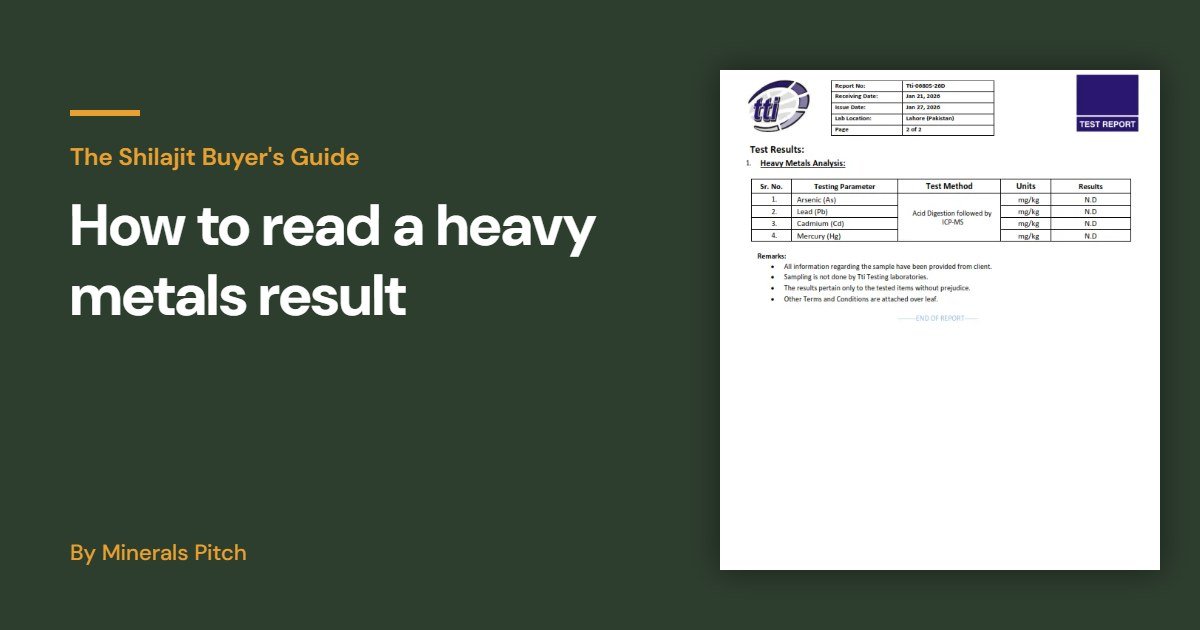
A brand can say its Shilajit “passed heavy metals testing” without showing you very much. The useful information is in the report itself. You don’t need a science background to read one, but you do need to know what to look for and how to do one small sum.
The short version
A heavy metals result tells you how much lead, arsenic, cadmium and mercury a lab measured in the sample it tested. It doesn’t automatically mean your jar is safe. To judge it, you need to know how much you’d take each day, which limit the result is being compared with, and whether the report matches your batch.
Start with the units
Most confusion starts here, because labs write the same measurement in different ways. These all mean the same thing: 1 mg/kg = 1 ppm = 1 µg/g.
Watch out for ppb, which is 1,000 times smaller than ppm. A result of 100 ppb is the same as 0.1 ppm, so always check the unit before comparing two reports.
Turn the result into a daily amount
A concentration only tells you how much metal is in each gram. What you actually take depends on your serving, so multiply the two:
Result in µg/g × grams taken per day = µg per day
Here’s a made-up example. If a report shows lead at 2 µg/g and you take 0.5 g a day, that’s 2 × 0.5 = 1 µg of lead a day. Use the maximum daily amount on your product’s label, not the smallest one.
Which limit is it being compared with?
There isn’t one worldwide limit. Some standards limit the amount in each kilogram of product, while others limit how much you take in a day. These are two common reference points:
| Metal | USP chapter 2232 (per day) | EU food supplement maximum (per kg) |
|---|---|---|
| Lead | 5 µg | 3.0 mg |
| Cadmium | 5 µg | 1.0 mg |
| Mercury | 15 µg (total) | 0.10 mg |
| Arsenic | 15 µg (inorganic) | Not listed in the summary we used |
USP is a voluntary US benchmark, and the EU figures are legal maximums there. Rules vary by country and can change, so treat this table as a guide rather than legal advice. Passing one standard doesn’t mean a product passes every other one.
Three details people miss
“Not detected” has a floor. It means the result was below what that test could measure, not that the amount is definitely zero. Look for the detection or reporting limit beside it.
Arsenic comes in different forms. Many reports give total arsenic, while USP’s daily figure refers to inorganic arsenic. If the report doesn’t separate them, it hasn’t given you the same measurement as that limit.
One report covers one sample. It tells you about what was tested at that time. It’s only strong evidence for your jar if the sample and batch details match.
Five questions to ask any brand
- Can I see the full report, not just a badge or a summary?
- Which lab tested it, and when?
- Does this report match the batch number on my jar?
- Which limits are you comparing these results with?
- What is the most I should take in a day, according to your label?
What a report can’t tell you
A heavy metals test doesn’t prove that a product is authentic, and it doesn’t cover microbes or mould toxins, which need separate tests. It also can’t tell you whether Shilajit is right for you. Don’t take it if you’re pregnant, breastfeeding or under 18, and speak to your doctor first if you have a health condition or take anything on prescription.
You can practise on ours: the Minerals Pitch lab reports are published online. Please check them with the same questions you’d ask anyone else.