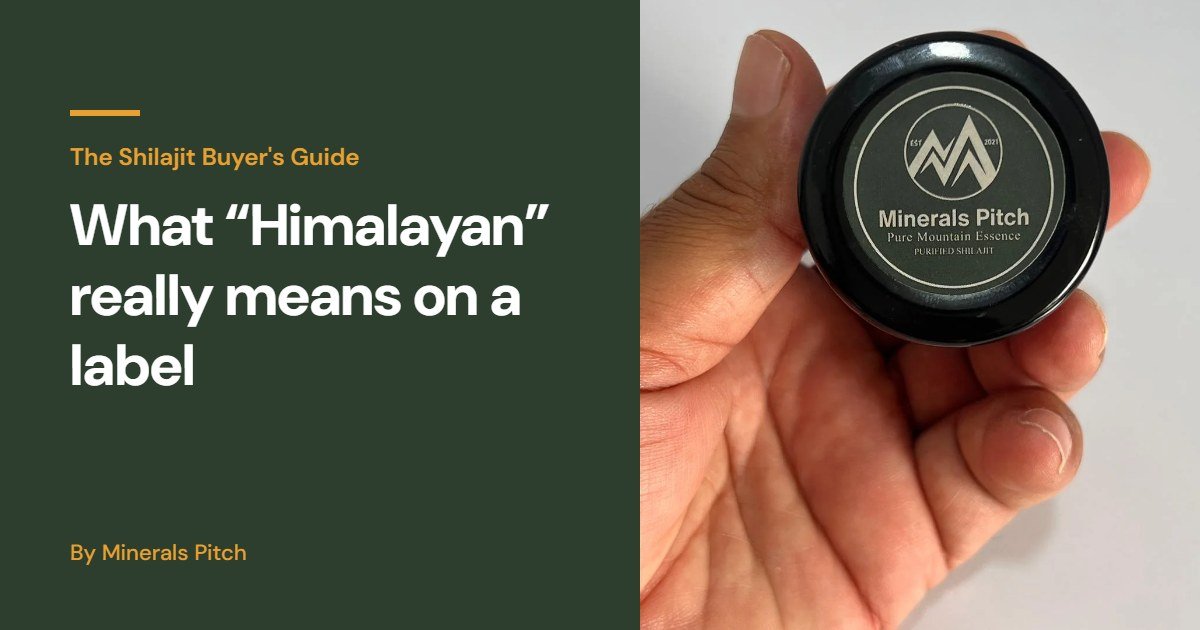
“Himalayan” is one of the most common words on a Shilajit label, and it sounds very specific. It isn’t. The Himalayas stretch across several countries, so the word tells you roughly where a product claims to come from, but not who collected it or how anyone knows.
The short version
Treat “Himalayan” as a claim to check, not as proof of quality. A good brand should be able to name the region, explain its supply chain and connect your jar to a batch record. Even then, origin tells you nothing about safety. Only lab results can do that.
Why the word is so broad
The Himalayan range runs through Pakistan, India, Nepal, Bhutan and China. Shilajit is also reported from other mountain ranges, including the Altai and the Caucasus. A label that only says “Himalayan” could therefore describe a very wide area.
Location matters because Shilajit forms from local plant matter and rock. Researchers have found its composition varies between sites, so two jars with the same word on the label may not be alike. That doesn’t make one region automatically better than another, and you should be wary of any brand that says it does without showing evidence.
Four kinds of place on a label
These can look like the same thing, but each one tells you something different:
- Where it was collected: the mountain region where the raw material came from.
- Where it was purified: this may be a long way from where it was collected.
- Where it was packed: “packed in” says nothing about where the Shilajit started.
- The seller’s address: a UK or US address tells you who to contact. Under UK food labelling rules, a business name or address doesn’t count as an indication of the food’s origin.
Also look out for mountain photos and brand names that suggest a place. These create an impression, but they don’t tell you where the product is from. UK rules can require origin information when leaving it out could mislead shoppers about where a food comes from. These rules are detailed and vary by country, so this is general information rather than legal advice.
How to check a brand’s claim
You usually can’t verify origin from the jar itself, so ask the brand these questions:
- Which country and region was this collected in?
- Who collected it, and do you buy directly or through a trader?
- Where is it purified and packed?
- Can you link the batch number on my jar to your records?
- Can you show me the process, not just stock photos of mountains?
A clear, consistent answer is a good sign, though it still isn’t proof. A vague answer such as “sourced from the pristine Himalayas” should prompt more questions. Check that the label, website and customer service all tell the same story.
What a lab report can and can’t tell you about origin
Standard lab reports for heavy metals, microbes and fulvic acid tell you about the sample that was tested. They generally don’t prove which mountain it came from, so be careful if a brand presents one as proof of origin.
The opposite is also true: a real Himalayan origin doesn’t make a product safe. Natural doesn’t mean free of contaminants, which is why you should check the results for your batch. Our guide on what a heavy metals result actually tells you explains how to read them.
Our answer to these questions
Since we’re asking you to question brands, here’s ours. Minerals Pitch says its Shilajit is collected by hand in Gilgit-Baltistan, Pakistan. Our Pakistani sister company is based in Abbottabad, and the brand is run by Neutrisa Ltd in the UK. Each jar carries a batch number, and you can email it to us to ask for that batch’s lab report. Read more about Minerals Pitch, and hold us to the same standard as anyone else.